Adventures in Advocacy / MaryAnne Roberto

Movements do not form out of the actions of one or two people.

When you study history you begin to see the patterns of how change occurs.  The frustrations of a relative few become the conversations and the questions that seek out others.

I thought it was just me

gets thrown by the wayside for

What are WE going to do about this?

CVI Moms, collectively WE have spent thousands of days, months, years knocking our heads on the brick wall that is the challenge of finding an appropriate education for a child with CVI.

For a long time, it thought it was just me.  I found out I was so wrong.  I wrote a blog post about Kate Keller.

MaryAnne Roberto, a CVI endorsed TVI and mother to 2 boys who are blind wrote a powerhouse of a letter using examples from history and her own story.

Read this letter.    Get ready to write your own.

MaryAnne Roberto
Envision CVI Consulting, LLC
envisioncvi@gmail.com

Craig Meador, President
American Printing House for the Blind
January 10, 2018
Dear Mr. Meador

I read your letter on the APH Facebook page about all the exciting things APH is doing in 2018 to “Make Big Things Happen”. As the mother of two boys who are blind, the information about advances in technology that will be highlighted and promoted in the new year was exciting. One of my sons is totally blind and gifted. He will benefit from the innovative technology that brings the written and graphic world quite literally to his fingertips so that he can access the same information as his peers.

Both of my sons are adopted, and spent their early years in orphanages in China where they were left to exist with no interventions, no education, no access to the world around them. The nannies in their orphanages loved them, I am sure, but had no ability to ‘break down the barriers of accessibility’ for them. They lived in a country where children who are blind are not educated, and are thought to be ‘less than’ the typical population of children.

People did not understand them, and gave them less than adequate tools to prepare them for learning and thriving. They were left out of most of what went on around them. And then, they were adopted, came home to a family with a mother who is a Teacher of the Visually Impaired, and father who is a former Health and Phys Ed teacher at a school for the blind. Their lives changed, and they are now thriving, learning, and in have great potential for success in their lives. Sounds like a fairy tale with a happy ending, right?

For the children with Cortical Visual Impairment in our country, there is no “happy ending.” 

Like my sons’ experiences in China they are often left to exist in classrooms and programs where there is little to no appropriate education and have no visual access to the world around them.

They are taught by teachers who have had inadequate instruction in their diagnosis, and treated by medical professionals who often do not understand this complex condition.

Their true potential cannot be known when they are not given a chance to experience it themselves.

‘Band aid’ programming is thrown at them, IEPs and strategies are guessed at and implemented, and team members are satisfied that they are ‘doing the best they can’ to serve the needs of the largest population of children with visual impairments in our country.

And so, when I read your post as a mother of two blind sons, I was of course excited about all APH had to offer for the future. But, to be honest with you, my sons’ needs are well-known to their teachers. They are registered for the Federal Quota, receive all the adaptive equipment they need, and are given appropriate services. Their needs are handled by professionals who write accurate goals, collect specific data, and order necessary materials for them.

At the same time, I read your post as a Teacher for the Visually Impaired, and a Perkins-Roman CVI Endorsed specialist, and I was quite disappointed. Nowhere in your post did you even mention the diagnosis that accounts for more than half of the children with visual impairments in our country. There was not a whisper of new advances in research and evaluations, no talk of new technology such as CVI Connect, no discussion of the growing need to reach the children who are learning to read in new and innovative ways.

Your post screamed of Braille access and instruction and was deafeningly silent on the children who are not taught to use their vision to learn, but are treated as if they have no vision at all.
I am privileged to work closely with many parents who are rallying to fight for appropriate services for their children with CVI. Much like Helen Keller’s parents, these parents are not willing to sit back and let the ‘powers that be’ provide inadequate services for their children. They fight long and hard and are met with resistance at every turn, and mostly from the world of educators of the visually impaired. Their voices are getting louder, and their cries are beginning to be heard. Unlike the Kellers, however, many of these families do not have the money or connections to affect real change, but slowly, surely, they are making changes in their children’s lives.
Yet, like Helen Keller and her family, who waited years to find an Annie Sullivan, these families are waiting as well. They are waiting for appropriate university programs that will educate future teachers on their children’s visual impairment, waiting for schools and programs to recognize the need for adequate services, and waiting for organizations like yours to put their children at the top of their priority list to ‘Make Big Things Happen’.
I write this letter to you as both an Annie Sullivan and a Kate Keller. As a mother of blind sons and a teacher of the visually impaired I know well the roads that both Annie and Kate walked, The road that Annie walked was paved with determination and fortitude. The road Kate walked was paved with tears and desperation for the little girl she loved so deeply. In our country today, there are far too many Kate Kellers whose roads are paved with tears and desperation, as they beg for appropriate services and materials for their children with CVI. The Annie Sullivans are ill-prepared to support those children or are not interested in learning new techniques.
And organizations like yours with national and international notability and resources have added to their frustrations and desperation by completely ignoring their children.

As Annie and Kate, I am writing to petition your organization to provide more comprehensive education and materials that will support children with CVI in our country. CVI Connect is one product that can be added to the Federal Quota program to give access to activities and much-needed data to support the students in programs to develop their visual potential. By promoting resources and education in CVI, you will quite literally ‘Make Big Things Happen’ for children, who like my own sons when they sat in orphanages half a world away, have little access to the world. We can do better for our CVI kids, and we can give hope to the thousands of Kate Kellers who cry in desperation for appropriate programming for their children.
Thank you for taking the time to read this letter. I would be more than happy to speak with you regarding your commitment to improve the lives of children with CVI through the American Printing House for the Blind’s resources and education.

Sincerely,
MaryAnne Roberto
Teacher of the Blind and Visually Impaired
Perkins-Roman CVI Endorsed Specialist


Thank you MaryAnne for this important lesson in advocacy!

Now, CVI Moms, what are we going to do about it?  

Moms on Monday #10 / Kate Keller from AL

We are going back in history for today’s Mom on Monday.

Since 2018 will be a year for determined (ok, fed up) parents to advocate for our children with CVI, I wanted to start the year with some historical perspective, and, perhaps, a different spin on a very familiar story.

You may recognize the last name of this particular mom from Alabama, just as you would recognize the name of her very famous daughter, Helen Keller.

We all know the story of “The Miracle Worker.”  Well, I hope we all do.  A few years ago, I learned that one state had dropped Helen Keller, her story and her books (The Story of My Life, Light in My Darkness, Optimism  & The World I Live In, to name a few) from their curriculum.  I don’t know if this is a common occurrence in today’s elementary schools.  I sincerely hope not because the story of Helen Keller’s life and her experiences with her gifted teacher, Anne Sullivan Macy, make for some of the most inspiring storytelling in American history.  Anne Sullivan Macy’s own harrowing childhood and fight for education makes her lifelong dedication to Helen Keller even more compelling.

Mark Twain coined the phrase, “The Miracle Worker” after he read of Anne Sullivan’s success teaching Helen Keller, a young deaf-blind child.  The Miracle Worker became the title of a play and a movie depicting Anne and Helen’s early days together.

It is a story of hope.

It is a story of determination.

It is a story of triumph over seemingly insurmountable odds.

And, as with every great story, there is more to it.

Before the story of the Miracle Worker could happen, there had to be parents who believed in miracles.

Kate Keller

Image:  Kate Keller

Captain Keller

Image:  Arthur Keller

In the 1880’s, after Helen was left deaf and blind following a severe illness at the age of 19 months, Kate and Arthur Keller spent years looking for a teacher who could reach her.   Their efforts went directly against popular opinion that children “like Helen” were not teachable.

Kate Keller wrote countless letters to schools and doctors across the country.  The Kellers often traveled for days from Alabama to see doctors in the northeast. They spent countless hours and dollars seeking out (often discouraging) “expert” opinions.

Years passed. As Helen grew more isolated, her behavior became more difficult to manage.  Relatives called Helen a “monster” and advised them to send her away.

That Helen did not languish in isolation and ignorance is the triumph of her parents who believed that  education (in the opinion of the time, “a miracle”) was possible.

Five years passed before the Kellers were introduced to Anne Sullivan.  Five years.

(As the parent of a child with CVI and multiple disabilities I have often said that the days last forever, but the years fly by.  I think about how long those five years must have been for Kate Keller.) 

helen and annie

Image:  A young Helen Keller seated on a chair holding a doll on her lap.  Anne Sullivan sits on the ground next to her.


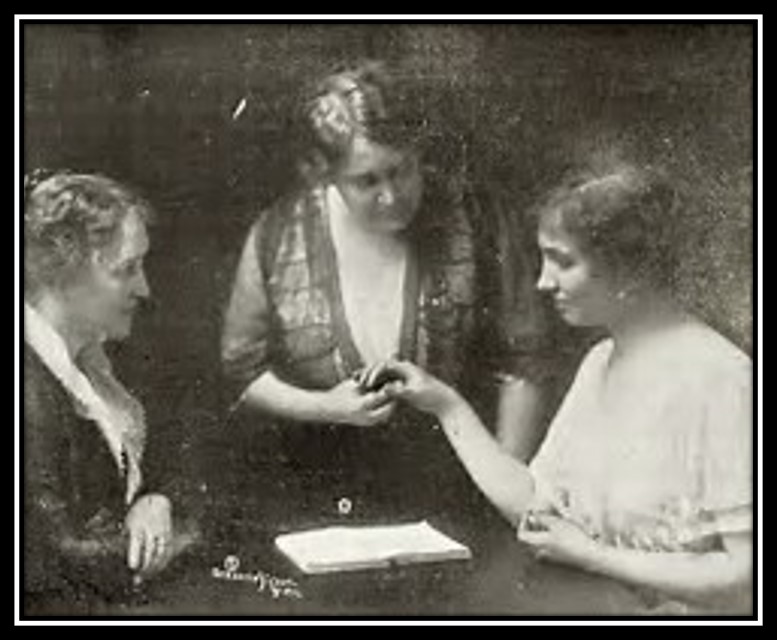
Kate, Annie, Helen

Image:  Kate Keller, Anne Sullivan Macy fingerspelling into the hand of Helen Keller as a young woman


Helen herself once wrote,

“No pessimist ever discovered the secret of the stars…or opened a new doorway for the human spirit.”

She could have been referring to her own parents whose dogged optimism found the special teacher who unlocked Helen’s fierce intellect and compassion.


Over seven years ago, when my daughter entered the public school system,  I found myself in the uncomfortable position of educating school systems about CVI and convincing people that my daughter can learn if they would learn how to teach her.  

I found myself wondering how Anne Sullivan came to work with Helen Keller.  I wondered what the Kellers had to go through to find her.

I wondered what Kate Keller went through trying unsuccessfully to communicate with her daughter who could no longer see or hear.

I wondered how difficult it was to hope against hope in an age before the telephone, before IDEA, before the Internet.   I struggled to maintain hope and I have those things.

If you are living with a child with CVI (and possibly other disabilities) and you are finding it difficult to find resources or services that can help you and your child, you probably have an idea about how determined and discouraged Kate Keller must have felt at times.

You may recognize how those two conflicting emotions washed over her  – buoying her or drowning her – as she watched her once bright eyed daughter lurch through the house, biting and pushing anyone who kept her from getting her way.  You may have an idea about how desperate she felt to reach her daughter again.

I do.

As a parent of a child with CVI and multiple disabilities, I am grateful to Kate and Arthur Keller for their tenacity and their sacrifice.

Today’s parents are better equipped to fight battles of education and inclusion because of the struggles of parents like them.

Woodrow Wilson (one of the many presidents Helen Keller met in her lifetime) once said

“The man who is swimming against the stream knows the strength of it.”

In honor of Kate Keller and parents of children with CVI across the country and around the world I’d like to update this quote for you:

The mom who is swimming against the stream knows the strength of it.

From history and from our own experience, we know the strength of the stream….(sing along if you know the words)….  a surprising lack of awareness about CVI in the medical and education communities, too few Teachers of the Visually Impaired, no hard, accurate data on the numbers of children with CVI, too few providers/teachers with the specific training necessary to work with children with CVI, low expectations…..

We know the strength of the stream.

Thankfully, we also know that education is not a miracle.

It is a right for every child.

The miracles are the children themselves.

What we do for them will be the best work we ever do.

————————————————————————————————————


Stone Walls and New Starts

Thank you to Ian Christy, Illustrator Extraordinaire, Designer,  & Cool Rockin’ Dad for the fantastic illustration in this post!

Imagine you were walking down the hallway of an elementary school.  As you walked, you saw brief glimpses through the slender window in each classroom door.  In one class, a teacher stands writing at a whiteboard, her students taking notes.  In another classroom, children gather on a rug for story time.

In the last classroom on the left, you see a similar scene.  Students sitting at their desks, raising their hands, doing their classwork.  You notice that one little girl’s desk is surrounded by a single layer of limestone bricks.

The next day, you walk down the hallway again to see the usual business of learning.  Some children are walking around their room going from station to station.  One class watches the teacher do a science experiment at the front of the class.

In the last classroom, however, you see the little girl’s desk is now surrounded by bricks stacked about 2 feet high.  She is sitting quietly. No one seems to notice them. The teacher stands at the front of the class continuing the lesson.  The students continue raising their hands.

You become concerned.  You return every day.  Every day you look into the last classroom on the left. Every day, the wall of blocks  gets taller and taller.  Every day, the little girl sits quietly, growing more isolated than the day before.  Every day, the classroom moves on around her.  You begin to feel anxious for the little girl.

She is being walled in, cut off from her teacher, her peers, her classroom, but no one seems to notice.  You stand at the window day after day and watch as she disappears behind cold, hard stone.  ian access

You knock on the door and ask the teacher why the little girl is being walled in.  She looks at you as though you have lost your mind.  She cannot see the wall.

You run to the principal’s office to tell him that the little girl is being enclosed in a kid sized stone tower.  The principal goes to look for himself.  He doesn’t see the wall either.

Every day the wall gets higher.

You demand a meeting with the principal, the teacher, and anyone else who works with this little girl.

You show them pictures of stone walls.  You bring them research about limestone.  You find articles from education experts who have studied children behind stone walls for decades, and, who have concluded  (surprise!)  that stone walls make learning very difficult.

Children cannot learn when they are cut off from everyone else.  Stone walls = bad for learning.

The team considers your presentation.  They reluctantly admit that – maybe – they noticed the wall from time to time.  An aide admits she tripped over a brick once but didn’t want to make a fuss about it.

Someone suggests that the stone wall may not be the little’s girl’s only problem.

“Sure,” you reply, “ she may have other issues, BUT, that STONE WALL IS NOT HELPING.”

The educational team takes another couple of weeks to develop a learning plan for the little girl.

Every day, the wall gets higher.

At another meeting, the team tells you that a teacher who works with “stone wall children” will take the little girl out of the stone wall to another room for 30 minutes a week.

But, she’s sitting behind the wall for every other minute of the school day!”

Then, Rod Serling comes out of nowhere, pats you on the head, mumbles something about how even The Twilight Zone wasn’t this surreal and disappears.


This seems ridiculous, right?  Or, sadly, mind numblingly familiar?

I have spent sooooo much time trying to explain to people that my kid does not have easy access to the world with her visual system.

I have walked by “Library Time” (my personal pet peeve for children with vision loss in a traditional school setting) where I’ve seen children with CVI sitting passively at tables in the back of the library while the librarian reads a book the size of a magazine to the children grouped at the front.

I have found “art projects” in my daughter’s backpack that were clearly colored in by the well meaning aide who finished it while Eliza was self-stimming in the back of the room.  (I know this because I went to art time one day and found everyone – Eliza’s aide included- sitting at the table coloring, except my girl, who was laying on the floor, rocking. I cannot make this stuff up.)

How are these examples any more ridiculous than watching in panic as a child is enclosed in stone, a situation that no one else seems to find problematic?

They aren’t.


To my fellow CVI families,

2018 is a new start. 

There will be opportunities for us as a community to work together to raise awareness about Cortical Visual Impairment and to demand that our children be educated in a manner in which they can learn.

In this year and every year that follows, we must demand access and expertise.  

Stay tuned

and

Happy New Year!


Love is who we are and no season can contain it…

Our family is having a low key Christmas this year.  We are staying home.

For the first time in awhile, when December rolled around I wasn’t filling notepads with lists titled “Gifts,”  “Meds and Feeding,” and “Sensory Needs.”  I didn’t have to run to Walgreens three times last week to refill prescriptions that always seem to run out if I even think about taking Eliza past the state line.  I didn’t have to cram our Christmas magic in the back of the car around the wheelchair, feeding supplies, sensory toys, and our very patient, long suffering dog, Rosie.  We did not drive 18 hours this year.  Hallelujah, amen, and cue the choir.

And, still, I’m beat.  I wonder if you are too.

This week, I heard the song, “Love is Christmas” by Sara Bareilles for the first time.  This song just spoke to me.   I was compelled to stop and listen.  The lyrics felt like better written versions of my own thoughts.  Nicely played, Sara Bareilles.  It was a poignant reminder of what my priorities are. Stains on the carpet do not even make the list.

Love is who we are, and no season can contain it.  This brought to mind all of the parents of children with special needs who make holiday magic happen on top of the other daily responsibilities that don’t go away just because “it’s the most wonderful time of the year.”

Love is how we do, let no judgment overrule it.  You know how much effort goes into caring for, researching, advocating for the children who love us and who lead us to be the best parents we can be.

Love is who we are.  Yes, I think that sums it up nicely.

If you are feeling worn down this holiday season, I offer you “Love is Christmas” from one mom to another.  Sorry about the ads.  Totally worth waiting those extra 5 seconds.

…………………………………………………………………………………………………………………………………………….


AND, if you are looking for something to watch during all of your down time in the next week (Ahahahahaha!  Whew, that was a good one.), may I suggest this video?

I still have a lot to learn about CVI.  So much information about CVI has to be pieced together like a puzzle for each individual child.  Every child is different. Every manifestation of CVI is unique to each child.

I always find Dr. Dutton’s presentations very educational.  It is good information to pass on to an early intervention or an education team.

Toward the end, he emphasizes the importance of being “radio parents.”  I had never heard this term before, but it made a lot of sense.

…………………………………………………………………………………………………………………………………………….

From one mom to another, I wish you and your family love and joy this holiday season and into the new year.  


Moms on Monday #9 / Meredith from IN

Good morning fellow moms and dads of delightful children who happen to have CVI,

Today’s MOM is Lola’s mom, Meredith from Indianapolis, Indiana.

Meredith has become a super advocate for her daughter and for young children with visual impairments in Indiana and Kentucky.  She is one of the driving forces behind Visually Impaired Preschool Services Indiana (VIPS Indiana), a non-profit agency that provides ongoing, best practice early intervention for infants and toddlers with severe vision loss.  She is also one fierce rooftop hockey player.

I got to meet Meredith and Lola through VIPS Indiana when Lola was a baby.  It is hard to believe that she will be 7 in January.

What does Lola like to do? What makes her laugh? What are her favorite activities, foods, etc?
Lola loves to do most anything that involves being outside. She loves parks, playgrounds, swimming pools and she especially likes to help walk the dogs around the neighborhood.

Lola adores her brother although sometimes she doesn’t understand what it means to give him space so she easily annoys him. Their relationship is much like any other sibling connection; they love each other one minute and are fighting the next. Lola especially likes clothes and shoes. We never really knew if Lola could identify colors since she can’t articulate it, but it has become very clear that yes she can absolutely differentiate colors as she hates pink and purple! She wants to wear blues and greens much like her brother. I’m so proud that she can now take off and put on her own clothes—I just wish she’d stop doing it 18 times a day!

Lola’s father makes her laugh like no one else. Now that she is paying attention more to her surroundings, she’ll start laughing when she sees or hears us laughing and the next thing we know—we are all laughing hysterically and we don’t really know why! It’s very sweet!

Lola loves almost all food but her favorites are cookies, pizza, chips, grapes, spaghetti and cereal bars. She doesn’t care for raspberries or watermelon. I wish her weight reflected her love of food—we’ll keep trying to get some meat on her bones though!

What do you like to do as a family?
As a family, we like to find playgrounds that are visually accessible for Lola. It’s sort of become a weekend hobby which is fun because we have learned where to take her and where to stay away from. She really needs high contrast in order to keep from getting bumps and bruises. We try to not keep her in a bubble since the world itself is not Lola-safe, but when she is on a playground that is all brown—for instance—she really struggles.

We also like to go to places like Monkey Joe’s or sensory-friendly gyms. Lola’s ability to sit and partake in an activity with us has increased dramatically over the last year so we’ll play her favorite game which is Hungry Hippo and she likes to color as well as play with Play-Doh. She also loves going to her grandparent’s house so many weekends are spent with them as well.

When did you first learn about CVI?
You know, I had a feeling something was wrong with Lola’s vision from the very second I laid eyes on her after she was born. I was always told that we would immediately lock eyes which indicated, “I am yours and you are mine” but Lola never looked at me. I gave birth to Lola in Costa Rica as my husband and I were living there at the time.  My nurses didn’t speak any English so I wasn’t entirely sure what to ask.

Lola’s Apgar  scores were perfect and the OB-GYN assured us that Lola was a healthy baby girl. We took her home and waited for the eye contact to kick in, but it never did. She sort of looked over our heads as if she was looking at a ghost standing behind us. She also wasn’t reaching for toys and she wasn’t tracking. My mother’s instinct kept telling me something was wrong and I was right.

Lola started to have infantile spasms when she was four months old and treatment to get the seizures under control began immediately. I started researching other symptoms associated with infantile spasms and I came across cortical visual impairment (CVI). When I read the characteristics, I knew right away that Lola had CVI.

How were you given the diagnosis?
As I mentioned Lola was diagnosed with infantile spasms by a neurologist in Costa Rica who was incredibly knowledgeable and supportive. When Lola was about seven months old, Dr. Luna gave Lola the CVI diagnosis yet we were less than shocked as we already suspected she had CVI.

Does your child have other diagnoses you’d like to mention?
Lola has an extremely rare genetic condition called Bosch Boonstra Schaaf optic atrophy syndrome. There are only about 40 in the world with the condition although as genetic testing becomes more available, researchers believe several hundred will be identified. So I thought Lola just had these two conditions, infantile spasms and CVI, I did not realize they were actually “symptoms or characteristics” of something bigger. As it turns out—they are. Lola’s seizures are under control, but she still has CVI, hypotonia, global developmental delay, nystagmus, autism, and more. She sounds complex and I suppose she is, but to us—she’s just Lola.

How was your child’s Early Intervention experience with regard to CVI? 
Are you ready for a shocker? After Lola completed her steroids for the infantile spasms, she was immediately referred to a therapy clinic. When we first walked up to the house (which looked like any other Costa Rican house), I immediately wondered 1) if we were in the right place and 2) how on earth would anyone in this place be able to help my baby? I was grossly mistaken as we met Lola’s very first physical therapist, Moises.

lola-pt-costa-rica

At Lola’s very first appointment, Moises stood at a whiteboard and explained exactly what CVI was to us—graphics and all! It was so comforting to have this information even as upsetting as it was. I learned right then and there something that has stuck with me at every turning point in this journey and that is; knowledge equals empowerment. When you give me information, I feel confident that I can do something with it. And so Lola began to see Moises once a week for PT, but working on her brain “learning to see” was always an integral part of her therapy sessions. She also began to see the occupational therapist, Melissa, who again, challenged Lola’s visual pathway during every single session. We couldn’t have asked for better providers during those early months and we are forever grateful.

Were your providers knowledgeable? Were they open to learning?
Moises and Melissa were more than knowledgeable when it came to CVI. They didn’t have to learn a single thing because they truly understood how CVI was impacting Lola’s development. It was rather impressive especially for being in a foreign country.

So as wonderful as the healthcare system was for Lola in Costa Rica, we knew that long-term it would be better for her to live in the U.S. We moved back to Indianapolis when Lola was just under a year-old. We immediately enrolled her in First Steps, Indiana’s early intervention system.

In First Steps, we had access to a PT, an OT and a speech therapist, but when I inquired about who would be helping us with Lola’s vision loss, I was told there wasn’t really anyone. I called around and found that information to be true and, ultimately, very shocking. How could we have better therapists for Lola’s vision in Costa Rica than the United States? It made no sense to me. But I wasn’t going to give up as I knew how important the first three years of Lola’s brain development was so I persisted until I found someone to help. I met Annie Hughes who was a Teacher of Blind/Low Vision and she worked for Visually Impaired Preschool Services (VIPS), a nonprofit that provides early intervention to young children with vision loss. Vision-specific home visits began and I finally felt as if we found exactly who we were looking for as Ms. Annie was more than knowledgeable!

How do you feel CVI is addressed in your child’s school setting?
Lola attends an Applied Behavior Analysis (ABA) center called Access Behavior Analysis in Indianapolis. While the therapists at Access had not worked with a child who had CVI prior to Lola, they were more than open to learning about it and how to set Lola’s environment up so she could thrive. After some lacking in the public school system, Lola will now have access to a Teacher of Blind/Low Vision who will consult with the center so that everyone understands Lola’s vision loss and how to make the proper modifications for her vision.

What do you know now that you wish you had known at the beginning of your journey as Lola’s mom?
This is a good question. I guess I wish I had let go more. That probably sounds ironic given that as a special needs parent, we may never truly let go, but I wish I didn’t worry myself sick so much. It was all so unknown and unexpected, but Lola was my baby so how could I not worry?

I just wish I would have spent less time immersing myself in the internet and more time enjoying Lola for exactly who she was. I wanted answers though. I wanted to know what her future looked liked. I always wanted someone to look in their crystal ball and tell me that Lola was going to be OK and, of course, nobody ever could. Sure I still worry, but I’m not debilitated by it. I acknowledge that some days will be tough, but they are few and far in between now and I’m very grateful for that.

I also acknowledge that CVI is not the only reason why Lola is delayed. Sure it is part of it, but I have now recognized that Lola is delayed because of her genetic condition. When she wasn’t walking at the age of three, I’d say, “She’s not walking because she’s visually impaired.” Now, I know that children who are completely blind can still walk even at an early age. I just wasn’t really willing to accept that she will always be delayed in some way, but that doesn’t mean she stops progressing. We celebrate the big, gigantic milestones as well as the tiny, most wouldn’t even notice inchstones! They all matter to us!
What would you tell a mother whose child has just been identified as having CVI?
You are not alone is the very first thing I would say. I think I would say please try your absolute hardest to not compare your child with others who have CVI (or even neuro-typical kids as well) as it’s just not healthy for you. I would also say that it does get easier over time. I remember when the ophthalmologist said Lola was legally blind and I about lost it, but what I realized is that Lola was still Lola. Those few extra words didn’t change a thing in that very moment. And honestly, having diagnoses will give your child access to MORE therapies and services. But I used to worry about CVI every day when she was little and now it’s not the first thing on my mind when I wake up. In fact, it’s the one of the last things I think about because CVI is just a part of our lives now.

What would you like for people who have never heard of CVI to know?
I would probably give them my normal CVI spiel about what CVI is, that many times CVI can improve over time (Lola can now see something as small as a raisin on the floor), that even though Lola’s vision has improved she still struggles greatly with her vision, and I’d like them to know that I have no idea how Lola sees the world. I’m willing to give just about anything to have a glimpse of how Lola interprets her surroundings, but I realize that may never happen.

Anything else? Hopes and dreams?
I think we are inundated with what society believes “success” of a child is. It means straight A’s, Honor Roll, graduating from high school, going on to college, finding a love to marry, having children, finding a career, and lots of other stuff in between. I’ll admit that I drank the Kool-Aid, too. When I was pregnant with Lola, my dreams for her were different than what has become her reality, but it’s OK.

View More: http://broadphotography.pass.us/howellfamily2016

Success for Lola means she’s happy, healthy, she loves, and she is loved. That’s all I want for her. Well, I kind of want her to move out someday, too, so I can catch up on nearly seven years of interrupted by Lola sleep!! But in all honesty, I just want Lola to be in a safe environment where people who know and love her look after her. I’m often asked if Lola will live with us forever and my immediate response is “HELL NO!” Now that’s not because I wouldn’t want Lola to live with us until the day I die, but how unfair would that be for her? She’s only six and she already wants to be out of the house so imagine when she’s 22. While she has her challenges, she knows she wants independence and we are going to honor that. She will always need help, but I will die more peacefully knowing that I have her support system in place so that she can live life without me. That’s so hard to write and perhaps I’m sharing too much, but my job as her mother is to think about her future. And Lola’s future will include lots of caring people because it does indeed take a village the size of China when you have a child with special needs.


Thank you Meredith and Lola!  

“What if Christmas…perhaps…means a little bit more!”

Good morning fellow families of adorable children who happen to have CVI,

This post is about gratitude for people who made my Grinch’s small heart grow at least 3 times this year.  (It’s just not the holiday season until someone quotes the Grinch.  You’re welcome.)

1. Javier

He is the kindest bus aide I have ever seen.  (And, believe me, I watch.) He does not know I am writing this, so I will call him “Javier.”  Javier greets us every morning with a big smile. He gallantly offers her his hand as they count the bus stairs together.  He asks her permission to help her scoot over and tells her when he is putting her bus belt on.  Eliza smiles when she hears his voice.  She takes his hand without any reservation.  She knows she is safe with him.  Because of this, I would offer this man a kidney without any reservations whatsoever.

Javier has seen me in the most mismatched excuses for sleepwear/sportswear as I roll out her chair every morning.  The man has never seen my hair brushed, folks.  He has also chided me for going out in the cold without a coat. In the rush of the morning routine, I hadn’t realized I needed one.  My mother would have approved.

Here’s the thing that GOT me.  One day, as Javier lowered the ramp to load her wheelchair, I noticed he was wearing a suit and dress shoes.  I thought maybe he had a job interview or a court appointment.   I didn’t think anymore about it, until a week later, when he wore another suit and tie.  I complimented his outfit again. He smiled, a little embarrassed by my effusiveness.

I realized the suit was a regular sort of thing, so I complimented him again the next week.

Javier shrugged and smiled.  “I just want to look professional.”

Shivering in front of our house, wearing mismatched socks, grubby sweatpants, and my husband’s t-shirt, I took that in.

I remembered one morning early this year when I went to Eliza’s school to watch how the bus transition was working.  Another bus carrying children with special needs was in line before Eliza’s bus.  The driver opened the door and came down the stairs to unload the equipment.

That guy wore a t-shirt that said – well, how do I put this?  The shirt had the emoji that most resembles chocolate soft serve (if you get my meaning) and it said “@#*t happens.”

What kind of message does a shirt like that send to the children and their families? And, to the other students?

Scowling, I watched “Mr. Soft Serve” lower two very complicated kids in wheelchairs to the ground without a word or a touch.  He transferred the boys like he was delivering boxes for UPS.

When Javier told me, a little sheepishly, “I just want to look professional,”  I realized the effort he put in to look his best for my girl and, I suppose, for me.

I had a sudden urge to hug this man and to make him president of the universe.  I did neither, since a restraining order from our local school system is one headache I do not need.  They already think I am weird enough.

hands

2.  5th graders rule the world

Eliza attends morning meeting at a 5th grade classroom in her school.  She goes in with an aide and her IPad or a Big Mack button to answer questions.

She also goes in with the widest smile I have ever seen on her face.

The students have welcomed her.  They call her by name when she comes in to see them and when they see her in the hallway.

Earlier in the semester, their teacher, Mr. K, and the principal allowed me to give a brief presentation to this class.  I talked about her diagnoses, especially CVI.  I asked them to identify themselves when they greet her because she has a hard time identifying people – even people she knows. I explained that she has difficulty with depth perception so she may walk unevenly and she might need to hold someone’s hand.   I told them it is a challenge for her to take in too much information – visual and auditory – at the same time.  I asked them to be patient with her and to understand that she can understand them, but that she needs more time.

Eliza’s teacher has been instrumental in scheduling the time necessary for these vital moments of social education for her.

This week, she sent me a few pictures of Eliza and some of the 5th graders outside during a break.  They were walking with her, holding her hand.

These are the first pictures anyone has ever given me of Eliza hanging out with a child who is not her own sister.  So, there’s that.  Where ARE the tissues when you need them?

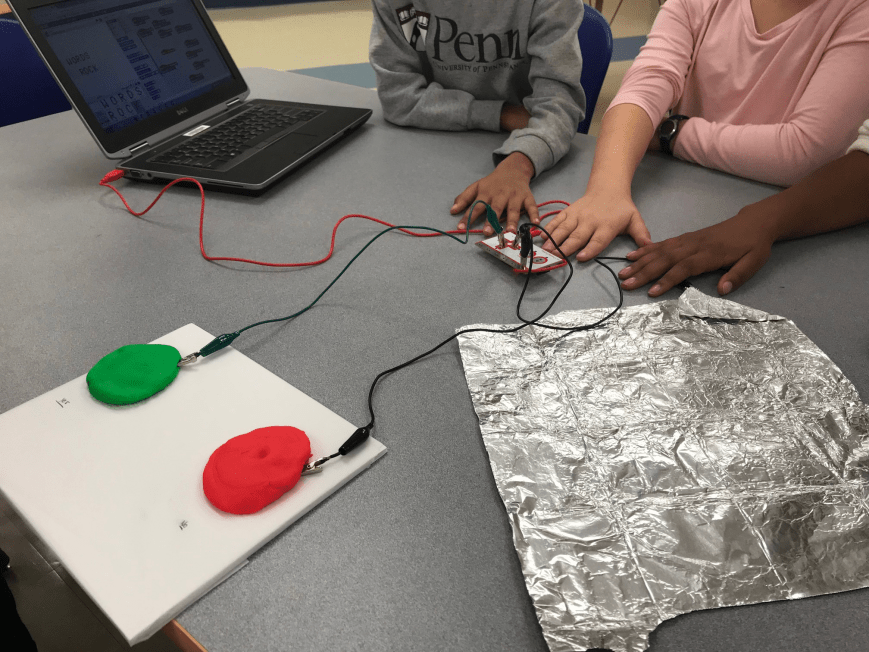
Ifyou read an earlier post, you may remember that 3 of the girls have come up with a project to make a communication device for Eliza.  They prepared a PowerPoint for Eliza’s teacher who sent it to me.

The girls met with us to try different materials for the switches.  They showed me, um,  wires and things, and there was a laptop involved… ok!  I don’t get this stuff!

As I sat there and tried to understand the technology speak coming out of their mouths, I realized

  1. They will be leaders some day. 
  2. Their compassion and their technological expertise will create new opportunities for children like Eliza. 

Last week, they presented their project to the PTA who agreed to fund the materials needed to make this device.  

They met a kid.  They were curious.

They saw a problem.  They came up with a solution.

They found a way to make it happen.

We will see what happens next after winter break.  I am looking forward to learning from these young ladies who are as kind as they are intelligent.

Yes, when 5th graders rule with world, we will all be just fine.

hands together

Here’s to the people who are gifts in our lives.

They brighten our days just by caring and extending a hand.


Moms on Monday #8 / Rebecca from VA

Good morning fellow CVI families,

Time is a precious commodity in the lives of parents of children with special needs.

The never-ending loop of Christmas songs in every public place and the constant parade of UPS trucks in your neighborhood means holidays are just around the corner.

During the holidays, the disruption of our routines and schedules makes life more stressful and time even more precious.

Dr. Roman-Lantzy says, “CVI moms are the busiest people I know.”  Now is not the best time to be writing up your story for a blog for other parents. You are in the throes of making holiday magic happen for your family.  That is what we do.

Since I have posted all of the Moms on Monday stories sent to me thus far, I will be today’s MOM.  And, because, I am today’s MOM, this post is late because that is how I roll (or write, or whatever, you know what I mean).

Maybe, after the holiday festivities are over, in the calm of the new year, you will consider sharing some of your stories with us.

Introduction:  I am Rebecca, Eliza’s mom.  She is 11 years old.  We live in Virginia.

(Fun fact:  Over the past 11 years, we have lived in 4 states.  Eliza was born in California.  She received early intervention in California and Indiana.  She has attended schools in Indiana, Kentucky, Florida, and Virginia.  Out of necessity, I have learned a lot about the differences between states in early intervention, early education and public school services. And, BOY, are there differences.) 

Here she is at about 11 months old.

Baby_E[1]


About your child: What does she like to do? What makes her laugh? What are her favorite activities? What do you like to do as a family?

Eliza is a social, curious and loving kid. She loves to be near other people, especially other children. Listening to other children playing makes her very happy. Her older sister is her favorite person on the planet. Eliza’s dad can make a noise that makes Eliza giggle like crazy every time. Her favorite activities include going for a walk, swinging, listening to music,  swimming, and jumping on a trampoline.  As a family, we go to the park and take long walks outside when weather permits.  We also take her to the pool as often as we can.

She LOVES music.  We spend a ridiculous amount of time changing the songs on her IPad or her CD player.  If I never hear Waterloo by ABBA again, it would be too dang soon.  I have Ziggy Marley’s Family Time album playing in my head right now. Also, I think we paid for Laurie Berkner’s car by incessantly playing her YouTube videos.  You’re welcome, Laurie Berkner.  My older daughter and I can sing a Laurie Berkner medley at any given moment.  Not everyone can say THAT, now can they?  Silver linings and such.

When did you first learn about CVI?  How were you given the diagnosis?

We knew before Eliza was born that she would have some challenges ahead.  We just didn’t know exactly what those challenges would be.  We were given the grimmest prognosis during the third trimester of my pregnancy before we even got to meet her.  That’s another story entirely.

At 4 months old, Eliza wasn’t tracking anything.  We took her to a pediatric ophthalmologist who called it  Delayed Visual Maturation and told us her vision would eventually develop normally.

“Don’t buy trouble,”  he told me. (Hmmm, well,  Dr. Expert Guy Mansplainer, maybe I’ll just rent trouble and take it for a test drive.

CAN I JUST SAY HOW ANNOYING and CONDESCENDING THAT PHRASE – Don’t buy trouble – IS? 

How many times are mothers of children with special needs or medical issues dismissed by a doctor who “knows better?” )

Which leads me to the truest thing I have ever seen on the Internet.

that which does not kill me

A neuro-ophthalmologist assessed Eliza’s poor vision at 9 months old.  He diagnosed Cortical Visual Impairment and Optic Nerve Atrophy.

We received a diagnosis, but, we also got the expert opinion from the neuro-ophthalmologist.

His expert opinion:  CVI may improve.  It may not.  There is nothing you can do about it.  Wait and see. Take her home, treat her like a blind child, and come back to see me in a year.  

And, what do we know now – 10 years later?

He was so very wrong.

I did not know how wrong he was, but, I could not accept that I would just go home and do nothing.  Just wait and see?  Moms do not work that way.  My heart could not accept his “expert” opinion.

I began researching CVI.  I bought Dr. Roman-Lantzy’s book.  I emailed her.  We met her in a hotel room in California where she was attending a conference with her husband, George Clooney.  (He loves it when I say that.)

Slowly but surely, we learned as much as we could about CVI and made accommodations to Eliza’s home environment.

AND, a year later, after we had worked on developing Eliza’s vision at home, when we followed up with the same neuro-ophthalmologist, he had this to say:

“I do not understand how her vision has improved so much.  I would not have believed it if I hadn’t seen it myself.  I don’t know what you are doing at home, but keep doing it.”  

This was when I handed him the copy of Dr. Roman-Lantzy’s book I bought for him.

I told him I knew he couldn’t “fix” CVI.  The prescription for CVI is educational modifications and strategies specific to each child’s unique learning needs.  It is education for parents, caregivers, and teachers about how the child has access to the world.

I told him I did not expect him to know how to address CVI, but I did expect him to stop telling parents to “Wait and see. There’s nothing you can do.”  I expected him to tell parents about educating themselves about CVI and to expect improvement.

He is still speaking to me, so I think it turned out okay.

Does you child have other diagnoses?  Yes, microcephaly and pachygyria of currently undiscovered cause, CP, epilepsy, global developmental delay, autism (age 4)

How is/was your early intervention experience?  How much time do you have?

000_0002 [325201]

A decade ago, there was very little consistent information about CVI on the internet.  Dr. Roman-Lantzy’s book was still new.  None of the early interventionists in vision loss in California had heard of CVI.

When we moved to Indiana when Eliza was 2 and still eligible for another year of early intervention, I discovered that Indiana did not have ongoing early intervention for infants and toddlers with vision loss.  Just didn’t have it.

Indiana offered families of young children with vision loss a yearly – roughly 2 hour- consultation from one teacher.  A fantastic teacher (Miss Annie from the Blue Bowl Story), but ONE teacher, nonetheless, for an entire state.  She had a caseload of over 300 families.

HOW IS THAT OK?  (It’s not,  but that is another story entirely.  That one has a happy ending, though, for another time.) 

Did I mention – that which does not kill me

I did the best I could to inform the early interventionists and therapists we’ve had over the years about Cortical Visual Impairment and the importance of ACCESS for children with vision loss.

ACCESS is what it is all about – whether the child has low vision from another diagnosis or CVI.

No therapeutic or educational program is going to work for your child if your child cannot access it. Yes, I’ll keep saying ACCESS until I’m blue in the face or every child has actual ACCESS to learning whichever comes first.  (A bluish tinge is more likely I think.)

Imagine you are sitting in a room and the answers to all of life’s most important questions are written on the walls around you – glowing in golden paint.  But, when you open your eyes, you see squiggles, shapes, and lines.  It could be hieroglyphics for all you know.  It has no effect on you whatsoever.

It does not matter how much brilliant, life-enhancing, brain stimulating information is around you, if you can’t reach it.

This seems like common sense.  It is.  But, it is astounding at how many typically sighted folks struggle to learn this lesson.

How is CVI being addressed in your child’s school setting?  

I have been the person who has brought up CVI and the issue of access at every IEP meeting we’ve had in every state we’ve lived in.  In her current placement, it has taken me the better part of 3 years to get CVI acknowledged, and to get the school district to agree to getting training for teachers, TVI, and support staff.  It is an ongoing process.  There are ups and downs. I’m learning a lot.  That is all I’ve got right now.

What do you know now that you wish you had known at the beginning of your journey as your child’s mom?   

Honestly, I wish that I had spent less time seeking out therapy after therapy.  I wish I had had regular access to an experienced TVI early on in Eliza’s life who could have told me to slow down.  I wish I could go back and tell myself that no one has all of the answers here and to trust myself more.

I wish I had known that the love and bonding time we had were as important as any hour spent in a clinic.  I wish we spent fewer hours in a clinic and more hours laying on a blanket watching the clouds float by.  Okay, technically, I’d be watching the clouds, but we’d be doing something together.

I also wish I knew as much about CVI as parents today know about it. There has been a lot of new, incredibly useful information to come out of Dr. Roman-Lantzy’s years of study and research, the work of Dr. Gordon Dutton, and Matt Tietjen’s What’s the Complexity framework.

I wish I had asked for more help.  I wish more help had been offered.

What would you tell a mother whose child has just been identified as having CVI?

You are not alone.  There are resources available.  There is a community of parents who have faced similar challenges.

Be gentle with yourself.  Be gentle with your child.  The foundation of any child’s success is the love and trust that grows between a child and her parent or caregiver.  It starts and ends there.

What would you like for people who have never heard of CVI to know?  

This is a population of complicated children, many of whom have survived because of the miracle of modern medicine.  It is time to recognize them and to rise to the challenge of meeting their needs.  There are more children with CVI than you know.  We need your help.

Hopes and dreams? 

My hope for Eliza is to help her get so independent that she develops her own hopes and dreams and that she has a way to tell me what they are.

One of my dreams is that every child with vision loss (whether or not the diagnosis is CVI) gets the educational support she needs from an early age to become independent, productive, and joyful.  Here is my definition of JOY  by the way. eliza in the car


P.S.  It would also be great if  no pediatric ophthalmologist or neuro-ophthalmologist ever again tells a parent of child with CVI that there is nothing she can do.

Maybe we will work on that in 2018.  Hmm?


Adventures in Advocacy / NE AER / Part 3

Be a life long learner about CVI.

Be a life long learner about the brain.

Ellen Mazel, the CVI Teacher (https://cviteacher.wordpress.com), offers this advice to parents of children with CVI and to the teachers who work with them.

In her presentation at the Northeast AER Conference, Ellen shared information on learning assessments and intervention strategies from her extensive experience as a Cortical Visual Impairment Advisor and a Certified Teacher of the Visually Impaired.

Her audience primarily consisted of TVI and COMS, however, everything about the presentation resonated for me as a parent.  Watching presentations from teachers who know CVI always help me broaden my perspective and recharge my batteries.  It gets discouraging being the only person at an IEP meeting who knows what Cortical Visual Impairment is and how it negatively impacts my daughter’s learning.

Sometimes, after a particularly frustrating day, I think, maybe, I am just kidding myself.  Trying too hard.  My girl is a complex kid.  She is non-verbal and has an additional diagnosis of autism.  We are struggling to find a consistent method of communication.  We do not get a lot of eye contact.  Interaction takes time and effort.  It is hard to read her.  It is hard to know what she understands.  

It is all too easy to develop low expectations for a complicated kid like her.  I have fought against low expectations in IEP meetings and in teacher-parent meetings, yet I have struggled to learn how to reach her myself.  

Ellen’s presentation reminded me that this is an ongoing journey.

Regarding the perspective of the parent/teacher:

  • The importance of presumed competence and eye contact.
    • CVI masks cognitive abilityOur children are often not able to maintain eye contact.  (Children with visual impairments cannot be accurately assessed by traditional cognitive tests.  IQ tests are not going to work on this population of children.) 
    • Research has shown that children who do not maintain eye contact get far less social interaction and attention from caregivers and teachers.  Be aware of this tendency to interact less with a child who does not maintain eye contact.
    • Since we cannot tell what a child who is not maintaining eye contact understands, we have to presume that the child understands and continue to teach the child in an accessible way.  
  • If we expect improvements, we will get improvements. The minute we do not have expectations, we are guaranteed not to get improvement.
  • Read articles and attend presentations.  – Research about CVI and the experience offered by CVI Range endorsed teachers will be found at conferences and in journals before you will be able to find it in a book.  

Regarding IEPs and Assessments:

  • The CVI range endorsement is the beginning of your journey NOT the end.  
    • Yes, we need to demand a teacher who has completed the Perkins-Roman CVI Range endorsement, however, it is only the starting point.
  • IEPs need to say “brain based visual impairment,” when diagnosed, by whom, the score, and the result of the Functional Visual Assessment (as it relates to CVI).  
  • When assessing a child, Ellen uses the CVI Range (Roman), Dr. Gordon Dutton’s survey, and Matt Tietjen’s “What’s the complexity” framework.
  • Remember that the parents’ interview gives all important visual history – if vision has improved – consider CVI
  • Best practice accommodations and modifications should be based on the CVI Range score 
  • Strategies need to be embedded throughout the day
  • Ellen puts together a salient features presentation so everyone on the child’s educational team uses the same language.
  • As a consultant, she advises that the IEP includes a 1 hour in-service about CVI and a 1 hour in-service about how CVI affects this particular child
  • Embed the theory that there is something visual in front of that child all the time.
  • Use more CVI supports in place when developing weaker visual fields.
  • Introduce yourself and use the child’s name so she knows you are talking to her
  • Limit touching and moving children while they are trying to look.

I’ll end with Ellen’s explanation of “infused advocacy,” or teaching the children how to problem solve for themselves.

Parents and teachers can start teaching a child to become a self-advocate by teaching her about the characteristics of CVI and by including her in the process of making her own accommodations and modifications. When a child understands that how she perceives the world is different from other people, she can learn to articulate her unique needs. She could ask other children to say their names when they approach her to help her identify them.   She could explain to her mom that cluttered rooms make her feel anxious or scared. She could tell her teacher that new places are confusing and ask for extra time to get to know a novel environment.

This part of a child’s education, learning how to articulate her needs, is so important.  We spend so much time talking about the kids.  Listening to them (or, in the case of a non-verbal children, quietly observing them) is even more important.

This is a fascinating and busy time in the history of Cortical Visual Impairment.  There is a solid foundation of knowledge and a growing current of educational strategies and research.  There is an active and vocal community of families around the world.  There are teachers who can guide us!

At the center of all of this activity remains the children who have to be equal partners in putting together the puzzle that is their picture of the world. 


Moms on Monday #7 / Gunjan from PA

Good morning fellow families of glorious children who happen to have CVI,

This morning, we have the pleasure of hearing from Krish’s mom, Gunjan.  Gunjan has been a force in advancing the work of the  Pediatric Cortical Visual Impairment Society and in advocating to raise awareness about CVI . At last year’s PCVI conference, she and MaryAnne Roberto, Perkins-Roman CVI Endorsed TVI, gave a presentation entitled Partners on the Journey:  A TVI and Family’s CVI Experience from Birth to Age 3.   You can find this presentation as a webinar on the Perkins E-Learning site : http://www.perkinselearning.org/videos/webinar/partners-journey-cvi-experience-birth-age-3

Gunjan’s family recently hosted a painting fundraiser for the PCVI Society and raised $1,500.  Here are Gunjan and MaryAnne at the fundraiser.

gunjan and maryanne

Gunjan’s determination is proof that If every parent could make an effort to raise awareness about CVI, to fundraise for the PCVI Society, as well as to challenge their teams to hone their CVI skills, the world might be a better place for our kids.”

Introduction: Gunjan, Krish, 5, Pennsylvania

About your child:  Krishy loves to dance, specifically, what I would term as interpretive dance, because he moves with music so well.  He loves to watch Super Mario YouTube videos, in other words, watching other people play video games on YouTube. He “practices” playing the games on his IPad by moving his finger, as if he is controlling the game, not the player on YouTube. He loves amusement park rides and most of all, he LOVES playing with his older sister and twin brother.  As a family, we do typical family things, like no-pants dance party and going to the playground.

We rarely go to the movies. (We saw Coco yesterday.  Krish doesn’t have the core strength to hold the foldable seat down, so he kept getting smooshed in the seat, besides the vision issues, of course, and the cost of taking a family of 5 to the movies!)  We definitely avoid large crowds, super-noisy places and anything too physically strenuous (for me or Krish, ha ha) to avoid sensory overload. 

When did you first learn about CVI? I learned about CVI the first day that our soon-to-be early intervention vision teacher came to our home for a consult when Krish was around 7 months old.  I had told our physical therapist that Krish wasn’t looking at me. 

How were you given the diagnosis?  We had an amazing teacher of the visually impaired, the famous MaryAnne Roberto, who suspected the diagnosis, and guided us to Neuro-ophthalmology, the Low Vision Clinic, Ophthalmology, and Dr. Roman-Lantzy. 

Our Ophthalmologist gave us the diagnosis, even though she didn’t completely understand CVI.  She did recognize that she didn’t understand.  

Does your child have other diagnoses you’d like to mention?  Krish is a former 26 week preemie twin with failure to thrive, mild hypotonic cerebral palsy, chronic lung disease and GERD.

How is/was your child’s early intervention experience with regard to CVI?  (Were your providers knowledgeable?  Were they open to learning?)  We had an AMAZING early intervention experience.  Most of our team members were open to MaryAnne’s suggestions of how to improve his PT, OT, feeding, etc. sessions with CVI interventions. (I fired the one who didn’t get it!)  MaryAnne had consultation time to work interdisciplinary.  We were able to get services for vision without a diagnosis of CVI. 

How is CVI being addressed in your child’s school setting?  Krish is in his 2nd year of Pre-Kindergarten.  I wanted him to get extra time to start learning sight words and other kindergarten skills.  He is in a typical classroom.  Both his current TVI and classroom teacher have demonstrated time and again their commitment to making him successful.  We are starting to use the iPad as his primary learning tool in school to adapt books, etc.  He has an occupational therapist who is also an assistive technology consultant (winner, winner, chicken dinner!!) She is helping to prepare him on how to use the iPad independently for learning and to use the best apps. 

We recently had a meeting with Dr. Roman-Lantzy and have decided to overhaul Krish’s IEP to include a 1-to-1 aide, so that ALL his materials can be adapted. 

What I learned was, just because he can do it, doesn’t mean he should.   He can look at a book, he can color, he can look up at a calendar on a complex wall, but doing all the things fatigues his vision and he becomes slower and slower at visual processing.  He is quick to fatigue both visually and physically.  If we create a CVI schedule and adapt all his materials, he will not fatigue as quickly and can absorb more information. 

What do you know now that you wish you had known at the beginning of your journey as Krish’s mom? 

In the beginning of this whole process, I wish I could have seen who he has become today. 

I prayed and wished he would walk and talk and see, but it was hard to have hope. 

I was tired ALL THE TIME. 

Also, the CVI resources that exist on the Internet now are amazing.  Even just 5 years ago, I couldn’t find the quality information available now. 

I would tell a mom whose child was recently diagnosed that whenever you are down-trodden and feel like you can’t verbally describe another illustration from a book or talk about the salient features of a hippo, remember that the vision of children with CVI, especially those who start with appropriate interventions at a young age, does IMPROVE! 

Additionally, if your child’s team doesn’t understand CVI, if the IEP doesn’t have CVI strategies that are specific to where your child’s vision is on the CVI Range, if the people who are teaching your child are resistant to learning about CVI,  GET A NEW TEAM!  Do whatever it takes to fight for your child’s right to learn to see. 

What would you like for people who have never heard of CVI to know?  If you have never heard of CVI, I would tell you it is more common than anyone could imagine.  Every child with CVI looks different.  It is a diagnosis that crosses medical diagnoses. 

Hopes and dreams?  Anything else you’d like to add?  Attending the PCVI Society Conference changed my life.  It was inspiring to meet families, educators, and medical providers who are motivated to improve the lives of a child like Krish.  It made me feel like I could do something to advance the cause of CVI.  Also, having Dr. Roman-Lantzy and MaryAnne Roberto as part of our team is like having unicorn glitter in my pocket, just invaluable.  Lastly, if every parent could make an effort to raise awareness about CVI and fundraise for the PCVI Society, as well as challenge their teams to hone their CVI skills, the world might be a better place for our kids.  

Thank you Gunjan and Krish!  May we all find unicorn glitter in our pocket!


Adventures in Advocacy / NE AER / Part Two of Three

Hello Fellow Families of Delightful, Sometimes Exasperating Children Who Happen to Have CVI and Who Sometimes Knee You in the Neck,
Why yes, maybe E did wake up at 4:30 this morning and kneed me in the neck while climbing into my bed. Once settled comfortably (for her) on my chest, she leaned over to kiss my forehead about a dozen times. It was pitch black, so let’s just say she missed a few times. In my semi-consciousness, I dreamed I was being water boarded.

This is an accurate description of the power dynamic in our relationship.

Moving on.

I promised more information from NE AER.  This post turned into a doozy.  So, I am splitting it in two.
To recap: There were 6 presentations about CVI at this conference! This is a big deal. Bravo to the Co-Chairs of the 2017 NE/AER Program Committee, Sharon Marie and Martha Delaney for their development of this year’s CVI track.
(You may want to reach out to the folks planning your area’s next AER conference. You could ask how many presentations they will be having on Cortical Visual Impairment. Just a thought.)
I was present for Peg Palmer’s presentation “Assessing children with CVI using Dr. Roman-Lantzy’s CVI Range,” Dr. Christine Roman-Lantzy’s follow up discussion following her “Implications of CVI in the Development of Literacy, Language, and Social Skills” presentation, and Ellen Mazel‘s presentation, “Serving our students with CVI: Learning Assessments and Intervention Strategies.”

Here are some of my takeaways from this conference:

The Perkins-Roman CVI Range endorsement is a necessary starting point and here’s why.  (Good to know for future stare-downs with school administrators about the importance of proper training for the teachers who work with our children.)

Right off the bat, Dr. Roman-Lantzy asked the discussion group if any of them were unsure about the CVI Range endorsement.
As a parent, I was surprised by this question. I’m just glad an endorsement exists  to give teachers the skills they need to improve educational outcomes for our children. I was more surprised when a few of the teachers raised their hands.

Dr. Roman-Lantzy asked them why they had reservations.
One of the teachers explained that she knew several experienced TVI who did great work with children with CVI but did not have the endorsement. Some teachers did not see the point of the endorsement. Some thought the CVI Range endorsement was extra work – more hoops to jump through at their own expense- for teachers who already had substantial experience working with children with CVI.
Dr. Roman-Lantzy acknowledged their doubts and agreed that there are experienced TVI who are more than capable of working with children with CVI. She mentioned that she herself is not endorsed.  (My mind was blown.)
Her point – an important one – was that while CVI has been discussed over the years within the field of the education of children with vision loss, there has yet to be a rigorous, commonly accepted standard of training for teachers to work with children with CVI.

(This leads me to paraphrase Ellen Mazel. My apologies to Ellen Mazel. )

The 2 most dangerous teachers Ellen Mazel has ever met are
1. The TVI who has never heard of CVI
2. The TVI who has been to one workshop / conference on CVI.
Boy, did that resonate with me. I wonder how many of us have had a teacher tell us – “Oh, I know CVI. I took a workshop once.”
Surely, it’s not just me. I bet I’d recognize the slight indentation on your forehead where you banged your head on the table after hearing these words. It’s okay. I’ve got one too.

We have been affirmed by the CVI Teacher herself!

This was worth the whole trip to Vermont, including losing my driver’s license, and, the resulting extra security patdowns to get home.
Now some history on the development of the CVI Range endorsement.

(Use this when you begin advocating for your child by telling your school system that a CVI Range endorsed educator is a requirement for your child’s ACCESS to her education.)
The lack of a standard educational protocol for training TVI to work with children with CVI has been a concern for Dr. Roman-Lantzy for years. In recent years, she went to the associations that recommend topics of study for university TVI preparation programs.

She asked them to recommend that CVI be included, to no avail.

Then, she approached Perkins School for the Blind.

Perkins met the challenge of training teachers to educate children with the #1 pediatric visual impairment in America and
First World Countries
(and tomorrow and 9 months from now and 2 years from now).

It’s not going away, folks.

To address the growing need, Dr. Roman-Lantzy and Perkins collaborated to create the endorsement and other classes surrounding specific aspects of CVI.
For their willingness to address the issue of CVI, this CVI mom applauds Perkins and its President and CEO, Dave Power. Dave Power is also the father of a son with dual sensory impairments. It does not surprise me that a parent of a special needs child made the decision to move the CVI Range endorsement forward.
During the discussion session, Dr. Roman-Lantzy explained that “no one is getting rich off of the CVI Range endorsement.” There are administrative costs to running the classes which are offset by the fees.
She further explained that the creation of the CVI Range endorsement was a way to acknowledge that every endorsee has the same foundation of knowledge about CVI and has the ability to use the CVI Range accurately and effectively.  The endorsement means you know how to use the CVI range, however, knowing how to address the unique learning needs of every child identified with CVI is an ongoing learning process. CVI is a complex diagnosis. It covers a wide spectrum of children with varied abilities. Research is still unfolding.

Learning all things CVI is happening for all of us in real time.
Hearing this discussion, I can understand why an overworked Teacher of the Visually Impaired with too many children on her caseload and fewer available resources would be dubious about extra training for a “new” visual impairment.

She does not have extra time. She is being pulled in too many directions. Depending on the state and depending on the day, she may be expected to provide early intervention in the morning for an infant with albinism in a neighboring county; at lunchtime, she may be pulled into an IEP meeting for a 4th grader with nystagmus; in the afternoon, she may be transcribing civics homework into braille for a high school senior who is blind.
Changes in our educational system to give TVI fewer caseloads, more resources, more extensive professional development, and the time it requires to do their job well need to happen yesterday.
It is simply too much to ask these teachers to do more.

BUT,

nothing about having a child with Cortical Visual Impairment is simple. 
Until we can get universities to add CVI to their teacher preparation programs

AND,
until we can make sweeping changes in the system of educating children with vision loss

We have to ask.

Our children can’t wait. (Ellen Mazel again, everyone!)

Yet, they are waiting.

Every day a child with CVI sits in a classroom without appropriate accommodations – without ACCESS – to her education, she is losing learning time.

The awareness of time lost is the motor that drives CVI parents to ask overworked teachers to learn more about CVI.  It is why we ask them to help us give our children access.

To wrap up this post, I will repeat what I said to the TVI and COMS in my presentation.

We need you to believe that our children can learn.  

We don’t expect you to have all the answers.  

Help us find the answers.  

We have to start somewhere.  

Thanks to these formidable ladies, we have a starting point.  


CVI ladies